What happens to your words
You're telling Soulve things about a real relationship. Here is exactly where they go, when they're deleted, and what Soulve does when a conversation is about something more serious than an argument.
The life of a mediation
Talk conversations are only ever seen by you.
- You share your side
Only Soulve reads it. The other person never sees your exact words, quotes or details that would identify what you said.
- They get the invite
They see a neutral topic line, like "splitting chores at home", with none of your words or feelings in it.
- You've both shared
Your words are deleted. What's left is the fair summary of feelings and needs, and the three ideas.
- You both say yes, or you don't
An agreement is only saved if you both tap Save. Either of you can delete it later, and it's removed for both of you. If anyone says no, nothing is kept.
- Never finished?
Mediations that are never finished are wiped after 30 days.
The rest, plainly
To reply, Soulve sends your messages and any screenshots to a third-party AI service. It asks before the first time, and it's only used to run Soulve.
We don't sell your data or use it for ads. Hosting and AI providers process it on our behalf, only to run Soulve.
Your email, name and photo are kept until you delete your account, which you can do anytime in Profile.
Ask to see, export or delete your data at support@soulve.app. In Spain you can also contact the AEPD.
The short version is also in the privacy page inside the app.
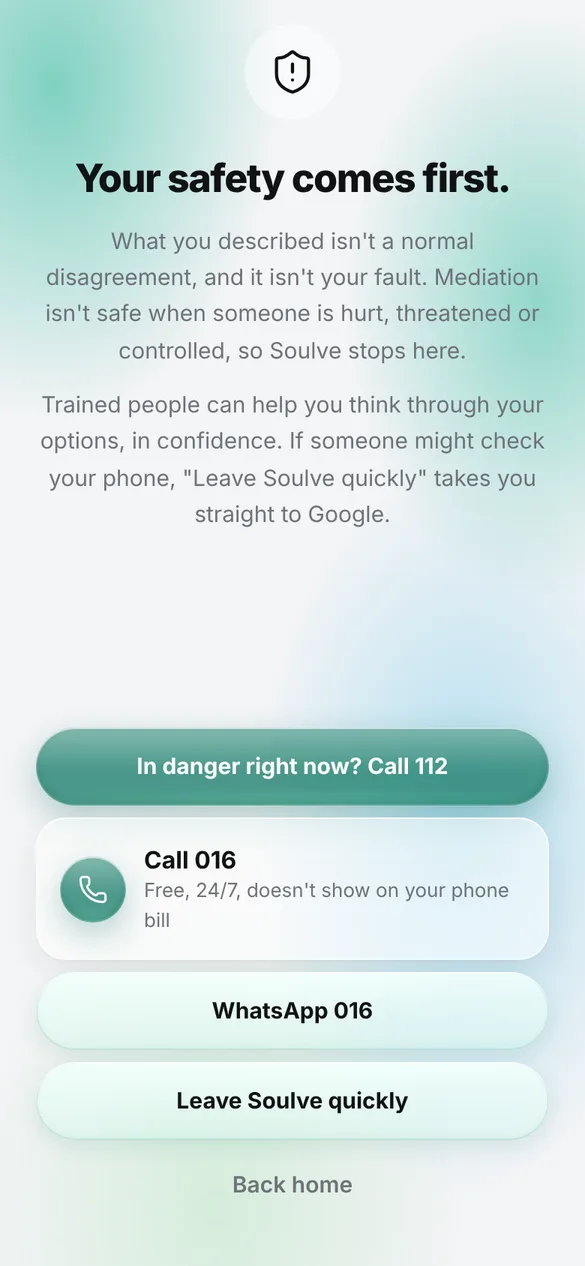
When something is serious, Soulve stops
Some things should never be mediated. In these cases Soulve stops immediately, even mid-conversation, and shows real people who can help:
- Suicide or self-harm, including indirect hints like "everyone would be better off without me". It shows a crisis line and encourages you to reach out to someone you trust.
- Violence, threats, fear or control, like someone controlling your money, phone or friends. It shows an abuse helpline, and a button that leaves Soulve quickly if someone might check your phone.
- Wanting to hurt someone. It suggests stepping away for 20 minutes and shows a crisis line.
When unsure, Soulve chooses safety. Ordinary exaggeration, like "I could kill him for eating my fries", doesn't count. Helplines are picked for your country: in Spain, 024 for suicide and 016 for violence, which doesn't show on your phone bill.
What Soulve isn't
Soulve is not therapy, not a crisis service and not medical advice. It doesn't diagnose anyone. If a disagreement keeps coming back, or one of you is struggling, a couples counsellor or therapist can help in ways an app can't.